
2026 Latest ExamcollectionPass 300-810 PDF Dumps and 300-810 Exam Engine Free Share: https://drive.google.com/open?id=1BN18DOhMUwyxjnIqfAA8xr7zNDGVM-xT
If you want to success in your career as a Cisco Certified Professional, you must think outside the box. It would be beneficial if you considered adding Implementing Cisco Collaboration Applications to your resume. To get this certification, you must pass the 300-810 exam conducted by Cisco. Passing the Implementing Cisco Collaboration Applications exam will help you advance your career. It is not an easy task to pass the Implementing Cisco Collaboration Applications certification exam on the first attempt, but now ExamcollectionPass is here to help. To assist you with remote study, ExamcollectionPass provides Cisco 300-810 Exam Questions to make your test preparation complete. The Cisco 300-810 exam questions simulate the actual exam pattern, allowing you to pass the Implementing Cisco Collaboration Applications certification exam the first time.
To pass the exam, candidates need to demonstrate their knowledge of the architecture, features, and functionality of these collaboration applications. They also need to have a deep understanding of the best practices for deploying and configuring these applications in different environments. 300-810 Exam covers a wide range of topics, including call control and dial plans, messaging, presence, and conferencing.
>> 300-810 Training Questions <<
Facing the incoming Cisco 300-810 Exam, you may feel stained and anxious, suspicious whether you could pass the exam smoothly and successfully. Actually, you must not impoverish your ambition. Our suggestions are never boggle at difficulties. It is your right time to make your mark.
Cisco 300-810 exam is designed for IT professionals who want to validate their skills in implementing Cisco Collaboration Applications. 300-810 exam covers a wide range of topics, including configuring Cisco Unity Connection, Cisco Jabber, Cisco Webex Teams, and Cisco Unified IM and Presence. 300-810 Exam also covers topics related to troubleshooting and maintaining collaboration applications.
NEW QUESTION # 207
Refer to the exhibit. When troubleshooting an internal Jabber login problem, there is a pop-up about a certificate error, and then the login fails The FQDN of Cisco UCM is cucm.ex.com. and the FODN of the IM and Presence Server is imp.ex.com.
Which two actions should be taken to fix this issue? (Choose two.)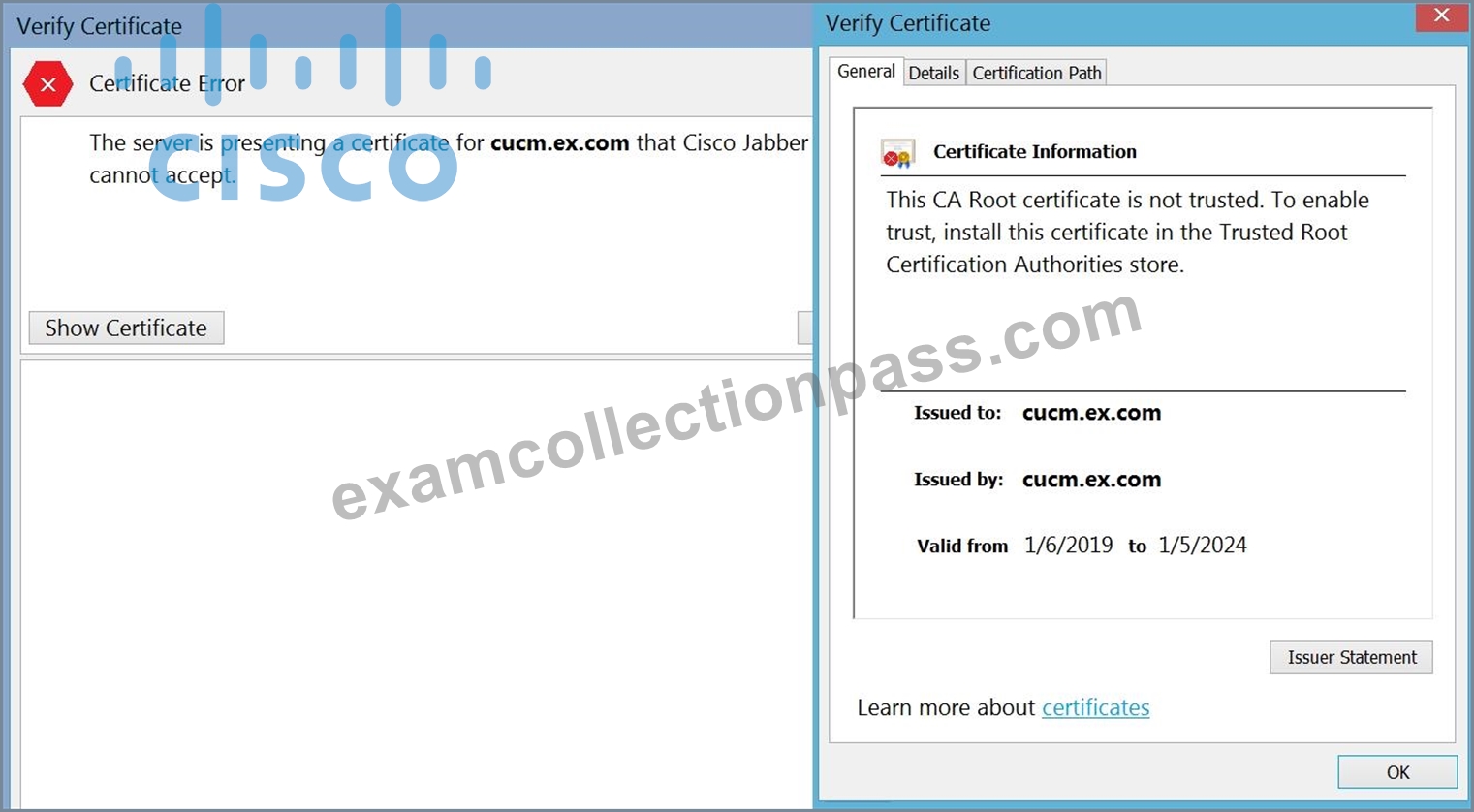
Answer: C,E
NEW QUESTION # 208
Refer to the exhibit. A collaboration engineer is troubleshooting an issue with Cisco Jabber for Windows deployed in phone-only mode.
The users are reporting that they cannot access voicemail services via the Cisco Jabber for Windows client on the corporate LAN.
Which steps resolve this issue?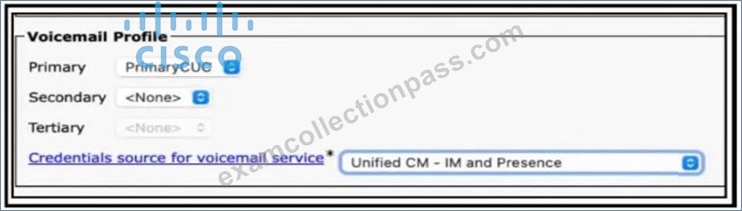
Answer: B
NEW QUESTION # 209
A collaboration engineer is troubleshooting Cisco IM and Presence high availability. The system is version
10.x. The engineer has confirneed that the server recovery manager service is configured using system defaults.
The engineer notices that user sessions have not fallen back to the homed nodes. What is the cause this Issue?
Answer: C
Explanation:
Explanation
This option explains why the user sessions have not fallen back to the homed nodes after the failed service or server was restored. The Client Re-Login upper limit setting determines how long the Jabber clients will attempt to re-login to their homed nodes after a failover event. If the failed service or server is offline longer than this setting, the Jabber clients will stop trying to re-login and will remain on the backup node until the administrator manually initiates a fallback or recovery. The default value for this setting is 30 minutes, but it can be changed in the Server Recovery Manager Service Parameters. References:
https://www.cisco.com/c/en/us/support/docs/unified-communications/unified-communications-manager-im
https://www.cisco.com/c/en/us/td/docs/voice_ip_comm/cucm/im_presence/configAdminGuide/11_5_1/cu
NEW QUESTION # 210
Which SAML bindings does Cisco UCM support to map SAML assertion and/or protocol message exchanges?
Answer: D
Explanation:
HTTP POST Binding:
This binding allows the SAML assertion or protocol message to be sent via an HTTP POST request, which securely carries the SAML data to the Identity Provider (IdP) or Service Provider (SP).
HTTP Redirect (GET) Binding:
This binding uses an HTTP GET request to send SAML protocol messages or assertions, where the data is passed as query parameters in the URL.
These two bindings ensure secure and efficient communication between Cisco UCM and an Identity Provider for SAML-based authentication.
NEW QUESTION # 211
In the integration of Cisco Unity Connection using SIP, which SIP trunk security profile option is required for MWI to work correctly?
Answer: C
NEW QUESTION # 212
......
300-810 Reliable Exam Sample: https://www.examcollectionpass.com/Cisco/300-810-practice-exam-dumps.html
What's more, part of that ExamcollectionPass 300-810 dumps now are free: https://drive.google.com/open?id=1BN18DOhMUwyxjnIqfAA8xr7zNDGVM-xT

